Sunday, July 17, 2022

 July 17, 2022, column from the Amarillo Globe-News

Touring some of God's gifts around the world brings gratitude

By Mike Haynes
                It started when I Googled “Beatle tour” in 2002, a search that took my wife and I on our first international trip. That guided visit to Liverpool and London still is the most fun Kathy and I have had outside the country.
                The most meaningful trip has been the visit to Israel in 2019 when we joined a church group to walk where Jesus walked – and where he died outside the Jerusalem walls and rose from the Mount of Olives.
                We’ve been to a few countries now, and this summer’s tour of Scotland confirmed again that the good gifts God gives us come in lots of shapes and sizes, some of them human.
                After we got off a train in Stirling, Scotland, we couldn’t see the historic castle there even though it sits high on a hill overlooking the city. We were on a street that felt like it was on a 45-degree angle, so we knew we were going on the right general direction – up – but as first-timers in the country, we still were a little lost.
 

               Kathy asked a young man walking by if he could tell us how to get to Stirling Castle. In a Scottish accent, he said something like, “Aye, just follow me,” and he went out of his way to lead us through a couple of turns until we saw signs pointing to the thousand-year-old structure.
                It was the same in Edinburgh, in Inverness and all through the Highlands. We decided that the Scots are friendly and helpful people.
                The other gift we weren’t expecting was the overwhelming beauty of the countryside. Not that we thought Scotland would be ugly, but its green mountains, its long, blue lakes such as Loch Lomond and the famous Loch Ness, its yellow gorse shrubs – flowering brightly everywhere in June – its shores and rocky islands put it among the loveliest countries we’ve traveled through.
                And animals: sheep everywhere plus cows, including a few Highland cattle, or “hairy coos.”
                Add centuries-old castles – some in ruins and some renovated for tourists – to the landscape, and you can’t beat “Scotland the Brave.”
                That’s the name of possibly the best-known bagpipe tune, along with “Amazing Grace,” and I truly believe good music also is a gift from God. At Dunrobin Castle, a young girl stood

outside the front gate playing the pipes for tourists. And at a ceilidh (a gathering, pronounced cay-lee) at the Old Smiddy Inn, a brother and sister duo, ages 14 and 12, entertained our group with bagpipe tunes they were preparing for a contest that week. Of course, all the pipers were outfitted in kilts.
                We got to stand on the iconic bridge at the St. Andrews Old Course, where The Open (Americans call it the British Open) golf tournament is ending its 150th edition today.
We weren’t fans of everything – such as the infamous national dish of Scotland, haggis, made of sheep’s insides – but the delightful outweighed the yucky by far.
                We visited cathedrals in Edinburgh (they say it, “Edinborough”) and Glasgow and a little chapel on one of the Orkney Islands built by Italian prisoners of war in 1943-44 from military huts, which brings to mind the murals done by Italian POWs at the church in the Texas Panhandle town of Umbarger.
                Like much of Europe and now the United States, church attendance in Scotland has dropped the past few decades, according to the BBC. The primary denomination is the Church of Scotland, which is Presbyterian, but our bus tour included only two brief mentions of John Knox, considered the founder of that church.


                We did see signs for the Free North Church and the Pentecostal Church in Inverness, but another old church building in that “capital of the Highlands” now is the Leake Secondhand Bookshop. A stately stone structure was identified as Stirling Baptist Church.
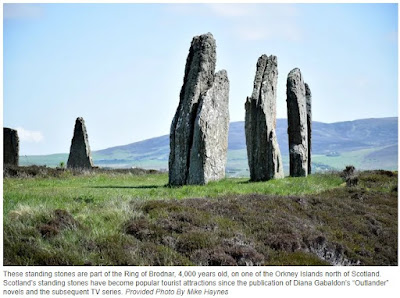
Attracting more attention from tourists than churches were the standing stones of Scotland, some older than England’s Stonehenge and much less crowded. On that Orkney Island, we visited the Ring of Brodgar, at least 4,000 years old, and the Standing Stones of Stennis, about 5,000 years old. Those stones have been especially popular since 2014, when the TV series “Outlander” featured a similar one that enabled the main character to travel in time from 1945 to 1743. Tourism in Scotland has skyrocketed as a result of the “Outlander” books and series.
      

          We had read up on Scottish history before our trip, so we were appropriately appreciative of two sites that are important to Scots. The beautiful valley of Glencoe was the location of the horrible 1692 massacre of 38 MacDonalds by British government troops led by members of the Campbell clan.
And like visiting the Alamo, we were reverent as we walked on the Culloden battlefield near Inverness. The 1746 battle also is a key plot point in the “Outlander” books and TV show, which explains why Kathy volunteered to take a photo of two women with a memorial stone – and why someone took our picture there.
The government army wiped out the Highlanders, led by “Bonnie Prince Charlie,” at Culloden, and the aftermath was prohibition of Highland clan culture, including tartans, bagpipes, weapons and the local Gaelic language, for more than 100 years.
                Learning about other cultures can be fun and richly rewarding, and I believe all that richness and fun is included in “every good gift and every perfect gift” that James says in the New Testament is “from above.” 
                Kathy and I don’t include haggis.

Sunday, July 03, 2022

 July 3, 2022, column from the Amarillo Globe-News:

'Elvis' has entered the building, evoking memories

By Mike Haynes

                As the credits rolled in a movie theater a few nights ago, my wife, Kathy, said something like, “That was awesome. I want to see it again.”

                I don’t believe we’ve seen the same movie more than once in a theater since “Titanic” in 1997. But I was thinking along the same lines, that this one was at least in my top 10 of all time.


Austin Butler plays Elvis Presley in the 2022 movie,
"Elvis." (Photo courtesy of Warner Bros. Pictures) 

               Of course, not everybody would agree, but director Baz Luhrmann’s take on the life of Elvis Presley – simply called “Elvis” – presents the music superstar in a way that touched us deeply, from his ecstatic rock ’n’ roll beginnings in the 1950s to his tragic death in 1977. Thirty-year-old Austin Butler captures the essence of Elvis, from the voice to the moves to the charisma, even if he isn’t a wax-figure lookalike. He and Tom Hanks, who plays Elvis’s manager Colonel Tom Parker in a subtly menacing manner, both should win Oscars.

                The story exaggerates some facts, such as how a proposed Christmas TV special turned into the 1968 “Comeback Special” that returned Elvis to pop culture relevancy and a consequential conversation by Parker and his protégé who make a deal on top of a carnival Ferris wheel. But it’s a movie, and the essential truth of what happened is there.

                Butler’s portrayal gives longtime fans and young newcomers a realistic idea of what Elvis’s appeal was to audiences, especially to women. But the actor also takes us into the mind and soul of a human being who had to deal with a conniving manager, a broken marriage and increasing loneliness at the top. Elvis was no saint and led a wild life at times. Abuse of drugs had to have been a factor in his death by heart attack. But his faith in God continually showed up in his life, if not in this film.

                “Elvis” begins with a boy in the rural South, watching black blues musicians in a shanty town and peeking into a revival tent at a charismatic church service that Luhrmann turns into a dreamlike, euphoric experience that sweeps Elvis up toward the sky.

                It’s well-known that gospel music was one of the staples in Elvis’s journey from childhood to his death at age 42. This movie only touches on that key part of his life, but it isn’t overlooked.

                In Pastor Greg Laurie’s new book, “Lennon, Dylan, Alice, & Jesus: The Spiritual Biography of Rock and Roll,” Elvis is quoted about an early church incident: “My mother and dad both loved to sing. They tell me when I was three or four years old, I got away from them and walked in front of the choir, and I was beating time.”

                One of his first ambitions was to be a gospel singer, and according to Laurie, soon after Elvis became a national star, he sang “Peace in the Valley” on the “The Ed Sullivan Show” because it was one of his mother’s favorite hymns. Elvis’s friend Jerry Schilling is quoted as saying, “Anytime Elvis was going through a really rough time, he always retreated to gospel music.”

                Laurie’s book says the singer’s ex-wife, Priscilla, tabbed Elvis’s “go-to” song as “Take My Hand, Precious Lord,” which includes the lyrics, “I am tired, I’m weak, I am worn through the storm; Lead me on to the light, take me home, precious Lord.”

                I’ve seen video of Elvis singing gospel songs informally with his backup singers, J.D. Sumner and the Stamps. He looks happy and joyful. Laurie points out that in 1967, the “Summer of Love” dominated by the Beatles, the Rolling Stones and Jimi Hendrix, Elvis released a gospel album, “How Great Thou Art.”

“He never lost sight of his Savior, but he did lose sight of himself, courtesy of an addiction to pills that turned him into a caricature of himself,” Laurie wrote.


Elvis' live album from 1972, one of the years he
performed at Lubbock Memorial Coliseum.

        Believe it or not, I saw Elvis in person. It was Nov. 8, 1972, at Lubbock Memorial Coliseum. I was there with my brother, David, and friend, Ted. My younger sister, Sheri, was 15 and invited to go with hometown friends, but Mom wouldn’t let her. Neither my brother nor I had been especially interested in Elvis, but I suppose we bought the $5 tickets because he was such a big name. That night changed our tunes.

                Elvis was touring the country while he wasn’t playing at the Las Vegas Hilton, previously the International Hotel. He had not gained the weight that he would later, but he was in his white jumpsuit period. We were in nosebleed seats, but that concert transformed our opinions.

                My brother and I both were blown away with the range of Elvis’s voice, his stage presence and the reaction of fans of all ages, especially women, some of whom he threw multiple scarves to. We entered the venue as music fans; we left as Elvis fans.

                I don’t remember any gospel tunes in the concert, but that voice and the heart that came with it gave songs such as “The Impossible Dream” and “American Trilogy” the weight of spirituality.

                After Elvis sang the words, “I can’t help falling in love with you,” for the last time, the crowd of 10,000 pleaded for an encore – only to hear the familiar, “Elvis has left the building.”

                Laurie tells a story in his book about a woman who approached Elvis after a Las Vegas show and offered him a pillow with a crown on it. “It’s for you,” she said. “You’re the king.”

                Taking her hand, Elvis reportedly said, “No, honey, there is only one King, and His name is Jesus Christ. I’m just a singer.”

                But what a singer.

Mike Haynes taught journalism at Amarillo College from 1991 to 2016 and has written for the Faith section since 1997. He can be reached at haynescolumn@gmail.com. Go to www.haynescolumn.blogspot.com for other recent columns.

Sunday, June 19, 2022

 June 19, 2022, column from the Amarillo Globe-News:

The legends behind St. Mungo of Glasgow

By Mike Haynes
“Here is the bird that never flew
“Here is the tree that never grew
“Here is the bell that never rang
“Here is the fish that never swam.”
If you’re like me, those four lines are new to you. Also new to me is the name of St. Mungo, a

The crypt of Glasgow Cathedral contains the tomb of St. Mungo.
(Photo by Mike Haynes)

missionary in Scotland in the sixth century who is credited with founding the city of Glasgow and is buried at Glasgow Cathedral, which my wife Kathy and I were blessed to visit this month. The bird, tree, bell and fish are associated with miracles attributed to Mungo.
Stay tuned for the fish story.
Kentigern, which means “hound-lord,” was Mungo’s real name. I don’t know its significance, but this man must have been quite zealous in spreading the gospel, and he also must have been a strong leader.
His nickname, Mungo, means “dear beloved,” which makes sense considering the adoration he has received centuries after his death around 612. Much that we know about him comes from two biographies written by churchmen in the 1100s that probably include more legend than fact.
According to Historic Scotland, Mungo was born at Culross, Fife, Scotland. His grandfather, King Loth, had put his mother, Thenew, in a boat to drift after she was accused of adultery. He ended up growing up in a monastery before traveling on his own, probably in his 20s, to do God’s work.
St. Mungo's tomb is in the lower level of
Glasgow Cathedral. (Photo by Mike Haynes)

The story is that he accompanied a cart carrying the body of Fergus, a holy man, looking for a burial site. Mungo let the oxen pulling the cart go where they wanted, and they stopped at the spot where Glasgow Cathedral now stands. Apparently Mungo already had a high position in the Catholic Church, because he eventually had a cathedral built at Glasgu, “the green hollow,” and became the bishop of a diocese there that corresponded with the British kingdom of Strathclyde.
The cathedral is one of two in Scotland to have survived the Reformation intact. It is part of the Church of Scotland, a Presbyterian denomination.
In addition to establishing a strong Christian presence on the Clyde River, where Glasgow eventually would surpass a million in population, Mungo’s reputation was built in part on four “miracles” summarized in those four “never” lines.
The bird: Mungo supposedly brought a robin back to life after some young friends had killed it.
The four miracles of St. Mungo
– the bird, tree, bell and fish –
are depicted on light poles near
Glasgow Cathedral. (Photo by Mike Haynes)


The tree: As a boy, Mungo was charged with being sure a fire at the monastery kept burning. He fell asleep, and the fire went out. He rekindled it with branches from a hazel tree that were either wet or frozen.
The bell: Mungo is thought to have brought a bell for the cathedral from Rome when he visited there.
The fish: This story is the most interesting. Queen Languoreth of Strathclyde was accused of adultery, and her husband, the king, claimed she had given her wedding ring to her lover. The king actually had thrown the ring into the Clyde River, but he demanded that the queen produce it for him.
She appealed to Mungo for help, and he had someone catch a salmon from the river. When the fish was cut open, the ring was inside, thus saving the queen from punishment.
I have not found a reason for the “nevers” in the miracle verse, but the four images have persisted not only in the church but in Glasgow civic life. They are on the city”s coat of arms, and the name “St. Mungo” has been applied to everything from a fireboat to a locomotive.

Kathy and I walked by Mungo’s tomb, covered with a colorful cloth and a small wooden cross, in the crypt of Glasgow Cathedral. (For some readers, I have to insert here that the lower-level crypt was used to represent a Paris church in filming “Outlander” scenes when the character Claire, working as a “healer,” took care of poor patients.)
The stories and legends may have been key factors in making Mungo beloved, but the evangelist himself probably would have preferred that people remember his saying that became the motto of his city:
“Let Glasgow flourish by the preaching of the Word.”

Mike Haynes taught journalism at Amarillo College from 1991 to 2016 and has written for the Faith section since 1997. He can be reached at haynescolumn@gmail.com. Go to www.haynescolumn.blogspot.com for other recent columns.


Thursday, June 16, 2022

 June 5, 2022, column from the Amarillo Globe-News:

A personal, inspirational message delivered at solo commencement

By Mike Haynes

                High school and college 2022 graduation ceremonies in our area are pretty much behind us, with young people letting loose happy shouts and sighs of relief. For most seniors, the celebrations start with scores or hundreds of capped-and-gowned ex-students walking across a stage while their names are read and maybe their images are projected on a screen for a few seconds.


                My wife, Kathy, her mother, Peggy, and I attended a ceremony a couple of weeks ago that was opposite in scale but at least as meaningful as the traditional events.

                Our 18-year-old niece, Hope, had finished her home-schooling, directed by her mom, Cheryl, who with her husband, Bill – my wife’s brother – were staging a solo commencement ceremony for their daughter. It might not be the thing for every senior, or even for every home-schooled student, but for Hope it seemed just right.

                And unlike many larger gatherings, God was invited.

                Cheryl had invited Hope’s youth pastor, Ashton, to speak at the 40-minute event at the family’s home in addition to three other teachers and leaders from their church. Mom and Dad also offered words of encouragement, and each of the speakers read a short passage of scripture. Friends and family were the audience.

                Kristie, one of the adult role models who spoke, pointed out an example of family loyalty. Several years ago while she was taking care of Hope and her younger brother, Nate, Kristie put Nate in a time-out for some small misbehavior. Hope emphatically sat down next to her brother in a show of solidarity for what she thought was unjust punishment.

                Most graduates don’t get such a personal ceremony with uplifting words directed specifically to them from people who know them well. Hope did. Wearing a purple cap and gown, she was commended not only for schoolwork but for impressive Bible memorization and for her creativity, especially in art and design.

                She and her 14-year-old brother, Nate, have learned about classical music, geography, history and all the other conventional areas of study, and both have soaked it up. Nate also is a technology whiz who can fix his granny’s computer problems. At the same time, their perspective has been biblical.

                One of the verses read at the ceremony was Proverbs 3:5-6: “Trust in the Lord with all your heart, and do not lean on your own understanding. In all your ways acknowledge him, and he will make straight your paths.”

That statement doesn’t mean to ignore your understanding or learning about the world but to view it through the lens of the creator of that world. It isn’t advice that is heard at many school graduation ceremonies, but at least in our part of the country, we still have baccalaureate services where graduates can be exposed to such wisdom. And at this event, it was central.

Hope’s dad, Bill – a certified public accountant and her home school “principal” – handed the diploma to her, followed by hugs from her parents and a catered supper for the guests. The new graduate also received an honor cord for her efforts to help and contribute to the learning of young children through the years.

                One encouragement during the ceremony could apply to every young person finishing their education in any setting. It’s Jeremiah 29:11:

“For I know the plans I have for you, declares the Lord, plans for welfare and not for evil, to give you a future and a hope.”


Sunday, May 22, 2022

 May 22, 2022, Amarillo Globe-News column:

'Where the Light Fell' delves into Yancey's upbringing, faith journey

By Mike Haynes

                I had no idea that the young author had endured such deep family trauma and spiritual struggle. All I knew was that his advice to a couple hundred eager writers in an expansive meeting room was inspiring.

                Philip Yancey was 29, an up-and-coming writer and one of the main speakers at the 1979 “Decision” School of Christian Writing, hosted in St. Paul, Minnesota, by the Billy Graham organization’s “Decision”


magazine. I was 28 and attending the long-weekend conference.

                I remember the thin, fuzzy-headed journalist talking about a recent story he’d had published in “Reader’s Digest.” I think it was about a woman who had been involved in some dangerous incident but survived and gave the glory to God. Plenty of smiles and head nods in the audience indicated approval of a Christian writer breaking into a mainstream magazine, and Yancey implied that “You, too, can do this.”

                He had only two books to his credit then, including the 1977 bestseller, “Where Is God When It Hurts?” His third, “Unhappy Secrets of the Christian Life,” came out in 1979. Knowing what I know now, it’s not surprising that Yancey’s early topics leaned toward pitfalls of Christianity and the church.

                In 2021, after more than 30 books, years of columns in “Christianity Today” magazine and acclaim as one of the top Christian writers of the past 45 years, his most personal effort yet was published. “Where the Light Fell” opens up Yancey’s childhood and early adulthood with no punches pulled, and the story isn’t always pretty.

                He had revealed some of his background in 2001’s “Soul Survivor: How My Faith Survived the Church.” In that book, Yancey described growing up in a fundamentalist church, how it caused him to doubt God and his eventual embrace of a more loving and grace-filled faith. In fact, grace has been a recurring theme in his writing, with 1997’s “What’s So Amazing About Grace” another of his many bestsellers.

                “Where the Light Fell” goes deeper into his family upbringing, starting with the tragedy of his pastor father, who died in his early 20s after contracting polio. Marshall Yancey and his wife, Mildred, had vowed to become missionaries in Africa, but Marshall’s polio and confinement to an iron lung ended that plan. With their congregation praying for healing, the Yancey couple decided to trust God as Marshall was removed from the iron lung.

                Ultimately, he couldn’t survive without the machine to help him breathe. Marshall Yancey died, and his wife made another vow – which Philip and his older brother, another Marshall, came to regard as a curse. She dedicated both boys to God as future missionaries to Africa.

                Much of the book details the unstable life the Yancey boys had after their father’s death, mostly a result of the strict hand of their mother. She became a well-regarded Bible teacher among fundamentalist Baptist Christians in the Atlanta area, but at home she railed at Marshall and Philip when they fell short of her religious and other expectations. Both boys were relieved to escape from home to a Bible college, but Marshall later lost his faith, and Philip seriously questioned his.

                Marshall drifted away from belief, eventually experiencing major addictions. Philip slowly floated in the other direction. His memoir describes how a love of nature, then music and finally, the college romance that led to his marriage drew him closer to a genuine relationship with God. Most of his life, he had struggled to move past a mechanical half-faith that he didn’t trust. But during a prayer session with friends, he had mystical thoughts of the Good Samaritan story. He saw himself as the wounded victim and Jesus leaning down to help him – only to have Yancey reject the Savior.

                The son of a preacher and of a devout mother, the college student who had grown up embedded in the church, told his future wife, Janet: “…I may have had the first authentic religious experience of my life.”


Philip Yancey

              It shouldn’t be surprising that an intelligent, talented, popular writer who has influenced thousands or millions has undergone such a dramatic switch from doubt and hostility to humble faith. C.S. Lewis comes to mind. But Yancey did, and soon after, in an essay he read to a college class, he said, “Something happened. … I was asking God to somehow, even though I didn’t want him to, give me the love of the Good Samaritan. Who loved irrationally, with no reason. …

                “I was the tramp and God was trying to help me. Every time he leaned over I spit in his face. What’s more, I wanted to remain a tramp. An intelligent, sophisticated tramp by choice.”

                Yancey says, however, that his conversion came during that dorm room prayer meeting. Like C.S. Lewis before him, he was a “reluctant convert.” Positive elements of his life had pushed him incrementally toward their originator, God. As the early theologian Augustine wrote, “I couldn’t look at the sun directly, but I could look at where the light fell.”

I knew nothing of Yancey’s journey when I saw him in 1979. I was just stirred by his exhortation to the fledgling writers not to settle for less than the best. He told us that modern Christian artists – writers, musicians and other creative people – didn’t influence our culture as they could because the quality of their work didn’t compare favorably to much that non-Christians were doing. Good intentions weren’t enough; standards needed to be higher.

I think that has changed somewhat since 1979. “The Chosen” TV series. Max Lucado. Christians are producing lots of thoughtful and creative books, blogs, movies, songs, articles and podcasts.

Well beyond his dark start, Philip Yancey has helped light the way.


Sunday, May 08, 2022

May 8, 2022, column from the Amarillo Globe-News:

Behind great Christian men are great Christian mothers

By Mike Haynes

                Most Americans have heard of Billy Graham, once called “America’s pastor,” and many know of Franklin Graham, his son who now is head of his late father’s ministry.

Anyone who’s spent much time in a Methodist church has heard of John Wesley, who founded the Methodist movement, and maybe Charles Wesley, writer of more than 6,500 hymns, including “Hark! The Herald Angels Sing.”

                On Mother’s Day, though, let’s take a quick look at two women who deserve their own accolades outside of the successful men in their lives.

Ruth Bell Graham

                Ruth Bell Graham, born in 1920, married Billy Graham in 1943 after the two met at Wheaton College, a Christian school near Chicago. If she hadn’t agreed to become the behind-the-scenes support of the world’s most famous preacher, she probably would have been a missionary in Tibet or China, where she had grown up the daughter of medical missionaries.

                It’s well known that as it turned out, Ruth kept the home fires burning in North Carolina, raising the Grahams’ five children while Billy carried the gospel around the globe. On the Graham ministry website, son Franklin recalled, “My mother was always bright and sparkly, even when she worried or would get only an hour or two of sleep at night. … Mother never went to bed until all of us children were back in for the night. She has that bright, cheerful personality, and I believe it comes from her daily walk with the Lord.”

Daughter Anne Graham Lotz, a speaker and author, remembered, “I would go down to my mother’s room early in the morning. Her light would be on, and I would find her at her big, flat-top desk. She would have about 14 different translations of the Bible spread out. She would be reading and studying her Bible.

“I would go down to her room late at night. I would see the light on underneath the door and I’d go in, and she would be on her knees in prayer.” Anne said she believes her mother’s daily walk with Jesus saved her from loneliness as her husband preached away from home for months at a time.

            In addition to managing the home and the kids, Ruth was a key counselor for Billy’s evangelism decisions and advised him on his sermons and books. She wrote or co-wrote 14 books herself, some for children and many featuring her poetry.

            Susanna Wesley was born in 1669 in England. Her father and husband both were ministers, but it was two of her sons who had a great impact on the world.

Susanna Wesley

            Susanna gave birth to 19 children, 10 of whom survived to adulthood. Like Ruth Graham, she was the primary presence in her children’s lives. She had a talent for organization, scheduling a daily hour to spend separately with each of her children, instructing them in the Bible and about life.

            According to a United Methodist history website, “When the children were small, she developed a remarkable and effective method of education and spiritual nurture.

“As they grew older, she wrote manuals for them on such topics as the attributes of God, the Apostles' Creed and the Holy Spirit. John, Charles and the other children relied on her wise counsel on matters spiritual, theological, and personal.”

With all of John Wesley’s achievements in advancing God’s Word, he was a failure at marriage, and his mother remained one of his major influences. In a 1732 letter to John, she gave child-rearing advice: “As self-will is the root of all sin and misery, so whatever cherishes this in children insures their after wretchedness and irreligion; whatever checks and mortifies it, promotes their future happiness and piety."

To her son Samuel, she wrote in 1709, “In all things endeavor to act on principle, and do not live like the rest of mankind, who pass through the world like straws upon a river, which are carried which way the stream or wind drives them."

Susanna Wesley died in 1742 at age 73. Biographer Susan Pellowe summed up her life: “…although she never preached a sermon or published a book or founded a church, (she) is known as the Mother of Methodism. Why? Because two of her sons, John Wesley and Charles Wesley, as children consciously or unconsciously, applied the example and teachings and circumstances of their home life.”

            Ruth Graham died in 2007 at age 87, 11 years before Billy followed her. Both are buried on the grounds of the Billy Graham Library at Charlotte, North Carolina. It’s telling that a Congressional Gold Medal awarded in 1996 had an engraving of the faces of “the Rev. Billy and Ruth Graham” on the front, recognizing the key role Ruth had played in the ministry.

            Ruth’s gravestone includes Chinese characters meaning, “righteousness.” It also quotes a highway sign she had seen years before: “End of construction. Thank you for your patience.”

            I’d say God’s construction of both Susanna’s and Ruth’s lives was on a firm foundation.


Sunday, April 24, 2022

 April 24, 2022, column from the Amarillo Globe-News:

From a life ruled by drugs to a life ruled by God

Kim Barlow

By Mike Haynes

                There’s a good chance you’ve seen him in TV commercials. He’s been in a bunch for more than one Amarillo retail company, and they usually involved some self-deprecating humor.

                His smile is almost as wide as he is tall, but for 18 years it hid something sinister. Kim Barlow’s life was ruled by drugs.

                Barlow and his three brothers had grown up attending church, but for him, it wasn’t having much effect on his life. In 1990, he was in his mid-30s, married and having an alcohol-fueled party at his house. Two of his guests had wandered into the garage and soon, one returned to the party and said, “Hey, Barlow, come out here a minute. We want to show you something.”

                The two guys had deposited two lines of whitish-amber powder on the hood of Barlow’s car, he later recalled, and urged him to sniff some of it into his nose with a straw.

                Thinking of his upbringing and about one of his brothers who was a police officer, Barlow resisted. But being called “chicken” and hearing “It isn’t going to hurt you,” he gave in and tried it.

                It was a form of methamphetamine, and that one experiment was all it took. He loved the energy and euphoria it gave him, and he couldn’t resist it. Barlow was on a downward slide for almost two decades.

                In April two years ago, he published a book called, “My Rehab Is Spelled J-E-S-U-S.” That’s a big clue that he would escape his descent into meth addiction, drug dealing, three divorces, jeopardizing his job, and considering shooting a man over a drug deal.

                His book begins with an account of another meth addict calling him at 2 a.m. one morning, desperate for some “stuff.” Barlow, then a dealer, was out of “stuff.” The man called him a liar, said he was coming to Barlow’s house and if he didn’t get what he wanted, “I’m going to kill you when I get there.”

                So Barlow got his 12-gauge shotgun out of a closet and sat, waiting.


He found out later that his meth customer did reach the house but for some reason decided to turn around and give up on his quest. Maybe that was God’s protection. Regardless, it brought home to Barlow the depth of the hole he had fallen – or jumped – into.

                His short book details the suffering that addiction brought to Barlow and to some around him. It also highlights the times when God was pointing to the direction of freedom. The turning point came in 2008 when someone emailed him a link to a video called “Cardboard Testimonies.”

About 20 people at a local church walked onto a stage, one at a time, each holding up a piece of cardboard with a negative message on the front and turning it around to a redeeming message on the back. “Christian men seemed weak” turned into “Now I am one!!” “Sideline Christian” became “Going to be a missionary.”

                With music praising God’s love, one young woman held up her cardboard message, “Was addicted to METH.” She turned it over to “Now addicted to HIM.”

                 Barlow described his reaction as a chill down his spine and tears down his cheeks. He felt ready to listen to God telling him, “Kim, this is enough. It is over, and I will take you out of this.”

Kim Barlow, right, prays with two people
at the Franklin Graham God Loves You
event in Amarillo in September 2021.
(Photo by the Billy Graham Evangelistic
Association)

                His book recounts an immediate decision to get rid of meth and everything associated with it. He says that the next day, he put several thousand dollars’ worth of drugs and paraphernalia in a box – his cardboard testimony? – and buried it in a dumpster.

                His turnaround wasn’t easy, but he ran from his addiction with the help of friends, family, a program called Celebrate Recovery and involvement in Walk to Emmaus weekend retreats. And this businessman who had successfully sold retail merchandise, then illegal drugs, couldn’t help but begin to sell the most valuable product of all, Jesus Christ. “I’m a pretty good promoter,” he said.

Barlow says conventional rehabilitation programs are important and necessary for many who are captive to drugs, alcohol or other addictions. But for him, his restored faith in God was the answer.

                Barlow, who retired from business in 2020, speaks to church and other groups – to pretty much anyone who will listen to his story. He started a Facebook group called “Real Men and Women Who Follow Jesus,” which has 14,600 members, and he has 4,900 friends on his personal Facebook page. He posts devotional messages every day.

                Last year, the CBN cable network featured him on “The 700 Club” in a six-minute segment called “My Return to the Father.” The narrator says Barlow now has a strengthened relationship with his daughter, Dawn. Fighting back tears in the video, the Amarillo salesman says, “Jesus is always there, and he is wanting to take you back to have a relationship with him.”


Sunday, April 10, 2022

 April 10, 2022, column from the Amarillo Globe-News

Remembering family reunions and "The Tie That Binds'

By Mike Haynes

                I don’t remember where I got my silly, brown tie that has the words, crudely written on it in iridescent green with a paint pen, “Blest Be The Tie That Binds.” Maybe I found it at a garage sale.

                It attracted me years ago because it brought to mind an annual reunion my family had attended for around 50 years. At the end of each weekend gathering, we would sing that Christian hymn before everyone departed for their homes.


                The Kunkel Reunion was a longtime tradition on my mother’s side of the family that brought together the descendants of Samuel Kunkel, who was buried in 1926 in my hometown of McLean, Texas. Of course, various branches of the family had different last names, and members of my immediate family plus my uncle, a Smith, joked every year that if you attended the reunion, you had been “Kunkelized.”

                On my dad’s side, we attended the Morse Reunion for many years. It didn’t last as long as the Kunkel one, which I think ran from the 1940s to the 2000s, but Dad’s kinfolks got together annually for 30 or 40 years. That reunion stemmed from my great-grandfather, J.S. Morse, who died at McLean in 1968, and others in his family.

                The Kunkel Reunion usually took place at the American Legion Hall in McLean, sometimes moving to Thompson Park or other Amarillo sites. The Morses moved around more, often meeting in McLean but sometimes in the mountains of New Mexico.

                The Kunkel group certainly was more organized. As long as I can remember, the reunion began with an informal gathering on Saturday night, a huge potluck dinner on Sunday (in our part of the country, the noon meal is dinner, not lunch) and then a formal business meeting where money was collected, officers were elected, minutes were recorded and those who had been born, married or died in the past year were recognized.

                And before that Sunday dinner, most of the group attended church together.

                Methodists and Baptists were the denominations most represented, so in alternating years, the congregation of one of those two McLean churches grew by 40 to 60 people on one Sunday in June. There were plenty of jokes about Baptists not dancing and Methodists not having an invitation to be “converted” at the end of their service.

                Sadly, both reunions have faded away. I’m still accused teased by my dad and siblings for “killing” the Kunkel Reunion, because at the last business meeting 15 or 20 years ago, I was elected president for the next year. By that time, most of my grandparents’ generation – the driving force behind the reunion – had died, and attendance had been low for a while. Drucilla, the family historian and secretary, was gone, and the usual practice of each family group sticking to its own table had gotten even more pronounced.

I talked to some of the remaining Kunkels and other relatives, and all agreed that it was time to fold up the card tables.

                The Morse Reunion came to a similar demise, although I wasn’t involved in that decision. Now some of us “younger” family members run into each other occasionally and say, “We should have a reunion again,” but so far, we haven’t.

                Another branch of my mother’s family, the Smiths, had a one-time event in 2012. Roger Smith, then pastor of Pleasant Valley Baptist Church, managed to get a big group of Smiths and relatives to a weekend at his church, and I’m glad. Four cousins of my mom’s generation posed for pictures, and a decade later, only one of them is left.

                I also was happy that I got to participate in a couple of reunions of my wife Kathy’s family. Her mom, Peggy, grew up in eastern Kentucky. She’s lived in Amarillo for more than 50 years, but she has visited her home in the heart of Hatfield-McCoy country most Memorial Days.

                On that weekend, the Francis clan traditionally has gathered to place flowers at mountain grave sites, eat the best fried chicken anyone’s ever had and sit on the porch telling stories and warning the kids not to get too close to the creek. I even got to meet a McCoy one year, kin to Peggy by marriage. I don’t think any Hatfields were invited.

                As with my family, deaths have reduced the number attending that reunion and worshipping at the pretty white Presbyterian church in the holler. The last time we visited Kentucky, I didn’t even get any fried chicken.               

                My mom has been gone since 2013, but the rest of the immediate family, consisting of my dad, three brothers, sister and their kids and grandkids, started a new tradition in 2021. We met in Ruidoso, New Mexico, for what we hope will be an annual Haynes reunion. My brother David’s wife, Ginger, had moved on to heaven unexpectedly, and David decided we could honor her by gathering in one of the family’s favorite places.

                Our family is no better or worse than a lot of families, but it comforts me that on big occasions, we do circle up and pray. There weren’t many dry eyes when about 25 of us did that around pizza boxes in a Ruidoso condo last summer.

                I used to get choked up, too, when Tom Caldwell’s bass voice would lead the Kunkel group: “Blest be the tie that binds our hearts in Christian love; the fellowship of kindred minds is like to that above.”